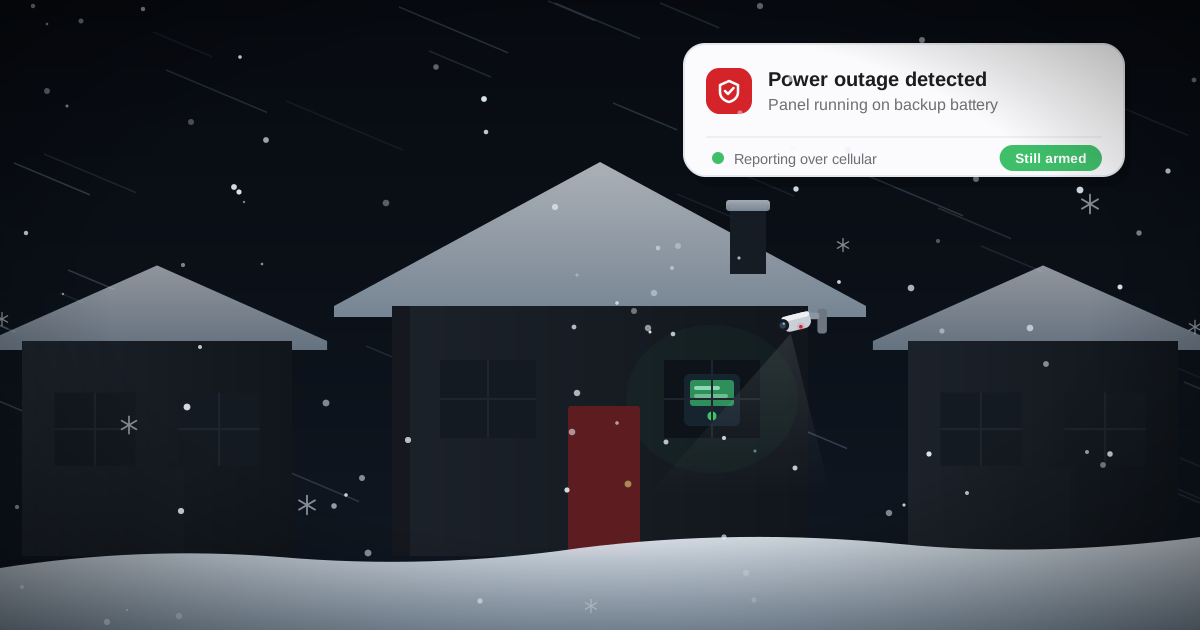
Ontario gets its real test of a security system somewhere between December and March, usually during an ice storm, usually at night. The power goes out across a few streets, and the question nobody thought to ask in July suddenly matters: is the alarm still working?
The answer depends almost entirely on choices made at installation. Here is what keeps running, what quietly stops, and how to find out which you have before you need to know.
The alarm panel: usually fine, for a while
A properly installed alarm panel has a sealed backup battery and switches to it automatically when mains power fails. The panel keeps monitoring sensors and keeps reporting.
How long depends on the panel, the battery and how much the system is doing. Backup batteries are typically sized for somewhere in the range of several hours up to about a day on a residential system, and sealed batteries generally need replacing every three to five years. A battery that has been in place since the system went in eight years ago may give you a fraction of its rated time, and you will not discover that until the outage.
What to do about it: ask your provider how long your specific panel is rated for and when the battery was last changed. Any monitored system should also report a low battery condition to the station, which is one of the quiet benefits of monitoring.
How the alarm talks to the outside world
This is the part that catches people out, and it has nothing to do with the panel battery.
- Internet or VoIP. If your panel reports over your home internet, it stops the moment the modem and router lose power, which is immediately. The panel is still armed and the siren still works, but the monitoring station is no longer hearing from it. Putting the modem and router on a small UPS buys perhaps an hour, which may be enough for a short outage and is not enough for an ice storm.
- Traditional landline. A genuine copper line carries its own power and often survives a local outage, but traditional lines are increasingly rare, and many lines that look like landlines are actually VoIP running through the same modem.
- Cellular. A panel with a cellular communicator reports over the mobile network on its own battery, independent of your power and your internet. Cell towers have their own backup power. This is why we fit cellular on anything rural, anything seasonal, and increasingly on everything.
If you are not sure which you have, that is the single most useful question to ask your provider this winter.
Cameras: the weak point
Cameras almost always stop in an outage, and people are often surprised.
- Wired cameras and the recorder draw mains power. No power, no recording, unless the recorder and the network switch are on a UPS.
- Cloud cameras lose both power and the internet connection they depend on. Battery powered ones keep running but have nowhere to send footage.
- A local recorder on a UPS keeps capturing even when the internet is down, so the footage is there when service returns. That is the arrangement we recommend where footage genuinely matters.
Everything else that quietly depends on power
- Smart locks usually run on their own batteries and keep working, but the hub or Wi-Fi they rely on for remote control will not. Know how to get in physically.
- Electric gates and garage doors stop. Learn where the manual release is before you are sitting in a driveway in freezing rain.
- Access control at a business may fail secure or fail safe depending on how it was specified. Know which, because it determines whether people can get out and whether the building is locked or open.
- Wi-Fi sensors and smart home devices stop reporting entirely.
What to check before winter, in about twenty minutes
- Ask how your panel communicates. Internet, landline or cellular. If it is internet only and you are rural or in an area that loses power regularly, cellular backup is the upgrade worth making.
- Ask the age of the backup battery. If it is more than three to five years old, replace it before the cold arrives, since cold weather reduces battery capacity on top of age.
- Test it. With your monitoring station notified, have the system put on test and the mains isolated briefly to confirm the panel holds and still reports. Your provider can do this properly as part of a service visit.
- Put the recorder and router on a UPS if camera footage matters to you.
- Check the sump pump. Not strictly security, but an outage during a thaw with a dead sump pump is a flooded basement, and a battery backup pump is a sensible pairing with water sensors.
During and after an outage
During: the system should keep working on battery if it is set up properly, and you may hear a trouble beep, which is the panel telling you it is on backup. Do not disarm and leave it disarmed to stop the noise. If you have a generator, run it safely and well away from the house, since carbon monoxide incidents rise sharply during outages. Monitored carbon monoxide detection matters most on exactly these nights.
After: check the panel has cleared its trouble conditions and returned to mains, confirm cameras and the recorder have come back, and verify the clock and recording schedule reset correctly. If the panel is still showing a fault an hour after power returns, call it in rather than ignoring it, because that is often a battery that did not survive.
The short version
A monitored alarm with a cellular communicator and a healthy battery keeps protecting a property through an outage. An internet reporting system with an eight year old battery stops being monitored the second the lights go out, and nobody tells you.
Finding out which one you have takes one phone call. If your system came from another company, we can test and advise on it either way through our takeover service, and our rural property guide covers connectivity in more depth for anyone outside town.
Common questions
Does a home alarm system work during a power outage?
A properly installed alarm panel switches to a sealed backup battery and keeps monitoring sensors. Whether it can still reach the monitoring station depends on how it communicates: a cellular communicator keeps reporting on its own battery, while a panel that reports over home internet goes silent as soon as the modem loses power.
How long does an alarm battery backup last?
It varies by panel, battery size and system load, typically from several hours up to around a day on a residential system. Sealed backup batteries generally need replacing every three to five years, and an older battery will deliver well under its rated time, so it is worth asking your provider for the age and rating of yours.
Do security cameras keep recording in a power outage?
Usually not. Wired cameras and the recorder need mains power, and cloud cameras also lose the internet connection they rely on. Putting the recorder and network switch on a UPS keeps footage being captured locally even while the internet is down.
Should I get cellular backup for my alarm system?
If your panel currently reports over home internet, cellular backup is the most valuable single upgrade for outage resilience, because it keeps the system reporting independently of your power and internet. It is close to essential for rural properties, seasonal properties and anywhere that loses power during storms.
What should I check on my security system after a power outage?
Confirm the panel has returned to mains power and cleared any trouble conditions, check that cameras and the recorder have come back online, and verify recording schedules and clocks reset correctly. A fault still showing an hour after power returns often means the backup battery did not survive and should be replaced.
Quotes and site visits are always free, and always pressure-free.
Get a free quote